

Not Every Award-Winning Business Should Scale
What Orange Pie Company Can Teach Us About
Smart Growth
When Ben Coster and Mitchell Brown sold their award-winning pie business, they weren't admitting defeat. They were making the smartest decision of their careers.
We saw this story in the local paper this week, and it stopped us in our tracks.
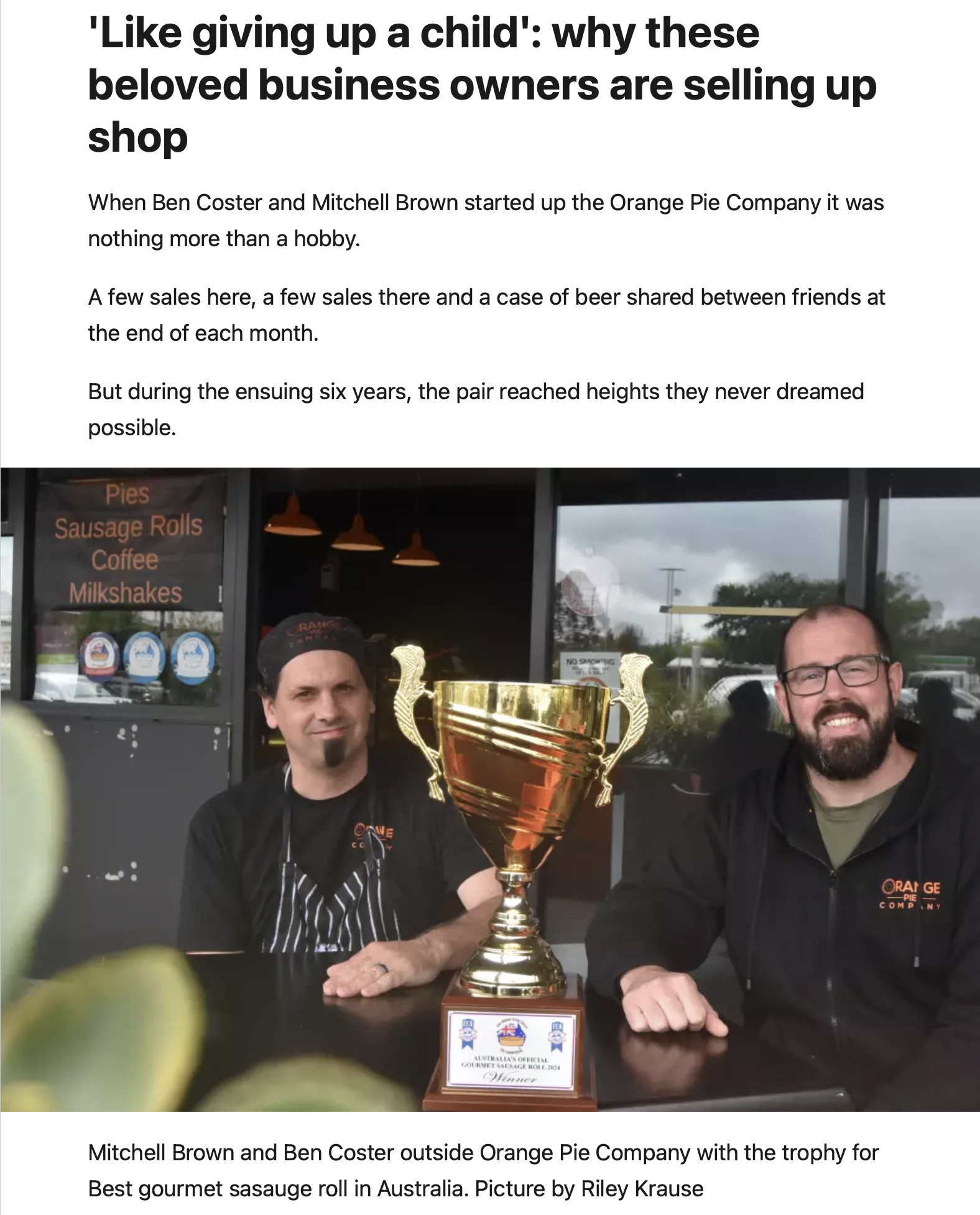
The owners of Orange Pie Company, an award-winning regional business, hanging up their aprons and chef's hats. "Madness!" we thought. But then we read on, and thought again.
Ben Coster and Mitchell Brown didn't just build a good business. They built an excellent one. Their maple bacon and hazelnut sausage roll won first place in the gourmet category at the Great Aussie Pie Competition in 2024. National recognition. Industry validation. The kind of success most small businesses dream about.
But success came with a price they weren't willing to pay.
"It's no longer about making pies, it's about running a business," Ben told the Central Western Daily. "There's a point where you're working every weekend, working every day and going 'what am I doing this for?'"
So they're selling. And they're being remarkably honest about why.
"How much further can we go?" Ben reflected. "There isn't much further."
This isn't a story about giving up. It's about knowing what you built, knowing what it needs next, and making the right call for yourself and your business.
The Growth Myth
Here's the uncomfortable truth: not every successful business needs to scale.
Not every regional business needs a franchise model. Not every award-winning product needs national distribution. And not every passionate founder wants to become a full-time operations manager.
But you wouldn't know it from the way we talk about business success.
The default narrative goes like this: start small, work hard, win awards, scale up, expand, grow, repeat. Anything less is seen as settling. Anything short of endless growth looks like you're not ambitious enough.
It's exhausting. And for many regional business owners, it's completely misaligned with why they started their business in the first place.
Ben and Mitch started Orange Pie Company as a hobby. A few sales here and there. A case of beer shared between friends at the end of each month. It was fun. It was theirs. It was enough.
Then it grew. Then it won awards. Then expectations shifted.
Suddenly, fun became obligation. Passion became pressure. And a business that started as a creative outlet became just another job, except this one consumed every weekend and every waking hour.
When Success Stops Being Fun
We see this pattern more than people talk about it.
A business takes off. Media coverage follows. Awards arrive. Customers multiply. And the founders find themselves running a completely different operation than the one they fell in love with.
The work shifts from craft to management. From making something excellent to managing people, systems, suppliers, compliance, growth targets. The very things that made the business special get buried under the weight of operational demands.
For some founders, that transition is exciting. They want to build systems. They want to scale. They're energised by the challenge of turning a small operation into something bigger.
But for others, it's soul-destroying.
"It stopped being fun," Ben said. And that's not a small thing. That's the entire point.
If you're working every weekend, sacrificing your time and energy, and you're not even enjoying it anymore, what exactly are you working for?

Knowing Your Ceiling
Ben's reflection, "How much further can we go? There isn't much further," is one of the most strategic things a business owner can say.
It's not defeat. It's self-awareness.
They know their capacity. They know their appetite for growth. They know the infrastructure, investment, and personal cost required to take the business to the next level. And they've made an honest assessment: that's not the business they want to run.
So instead of pushing themselves into burnout trying to become something they're not, they're making a different choice. They're selling to someone who does want that growth path. Someone who has the energy, resources, and ambition to take Orange Pie Company to places Ben and Mitch can't, or don't want to, go.
That's not weakness. That's strategic thinking.
The Regional Business Reality
Regional businesses operate in a different context than their metro counterparts.
They're often deeply embedded in their communities. They're known. They're visible. Success is public, and so is struggle.
When a regional business wins national recognition, the community celebrates. But that celebration comes with expectations. Suddenly, you're not just a local pie maker. You're the award-winning pie maker. People expect you to grow. To expand. To put the region on the map.
The pressure is real, even when it's well-meaning.
And the infrastructure challenges are real too. Scaling a regional business means navigating different supply chains, different labour markets, different growth limitations than businesses in major cities face.
It's not impossible. But it requires a level of commitment, investment, and operational complexity that not every founder wants to take on.
Small, Excellent, and Community-Focused Is Still Excellent
Here's what we want regional business owners to hear: you don't owe anyone endless growth.
You don't have to franchise. You don't have to go national. You don't have to become something bigger just because you could.
Small, excellent, and community-focused is a legitimate business model. It's a legitimate ambition. It's a legitimate endpoint.
If you built something that serves your community well, employs good people, produces excellent work, and sustains your life without consuming it, you've succeeded. Full stop.
You're allowed to stay that size. You're allowed to say "this is enough." You're allowed to choose sustainability over scale.
And if you reach a point where the business needs more than you can give it, or wants to grow in directions you don't want to follow, you're allowed to pass it on to someone who does.
That's not giving up. That's good stewardship.
What This Means for Your Business
If you're reading this and thinking about your own business, here are the questions worth asking:
1. What did I build this business to be?
Not what could it become. Not what others think it should be. What did you actually want when you started?
2. What does growth cost me?
Not just financially. What does it cost in time, energy, relationships, and joy? Are you willing to pay that price?
3. Am I running the business I want to run?
Or am I running the business I think I'm supposed to run based on external expectations?
4. What does success actually look like for me?
Is it revenue? Is it reputation? Is it freedom? Is it pride in your work? Define it for yourself, not based on someone else's scorecard.
5. What does this business need next?
And are you the right person to give it that? If not, what's the smartest next move?
These aren't easy questions. But they're important ones.
And if you're facing them, you're not alone.
When to Get Help
The hardest business decisions are rarely about numbers. They're about values, capacity, identity, and what you're willing to trade for growth.
That's where strategic communications support makes a difference.
We work with regional businesses and ambitious founders navigating these exact questions:
What story are we telling about our business, and does it still fit?
How do we communicate a decision that might surprise people?
How do we protect our reputation while making a change?
What does growth look like if we don't want to scale the traditional way?
If you're thinking about what's next for your business, whether that's growth, pivot, sale, or something else entirely, we'd love to talk.
Not to tell you what to do. But to help you think through what's right for you, and communicate it in a way that strengthens trust and protects what you've built.
Final Thought
Ben and Mitch built something worth celebrating. An excellent product. A respected brand. A business that brought joy to their community and pride to their region.
The fact that they're selling doesn't diminish any of that.
If anything, their honesty about knowing their limits and making a strategic choice deserves more respect than pushing through to burnout for the sake of appearances.
We hope they're proud of what they built. And we hope whoever takes over Orange Pie Company next treats it with the care it deserves.
As for other regional business owners reading this: you're allowed to make the choice that's right for you.
Excellence doesn't require endless scale. Success doesn't require sacrificing everything. And knowing when to stop is just as strategic as knowing when to start.
If you're thinking about what's next for your business, let's talk.